
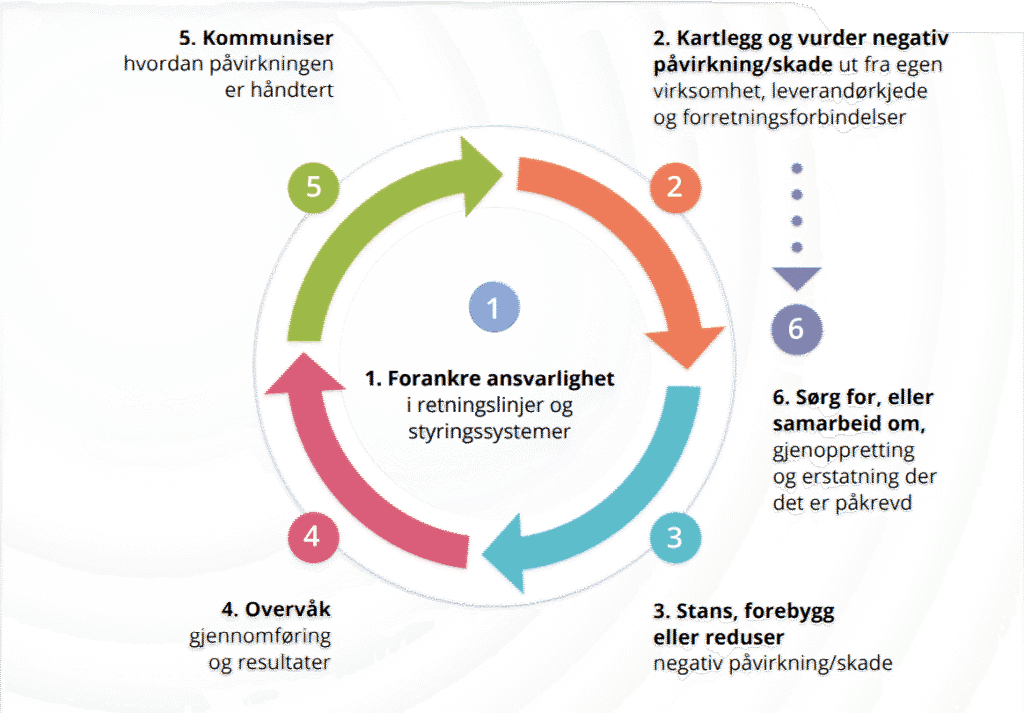
Our “Responsibility Guidelines” are based on the “OECD Guidelines for Multinational Enterprises” and describe how we should act responsibly. The guidelines are anchored in the Board of Directors and apply to all our employees, business partners and other parties directly associated with IPOA.
We will hold a working meeting to conduct due diligence assessments at least once a year. The working meeting will include a risk assessment related to our purchases of goods and services. We will seek available information about supply chains and risk assessments from industry associations to which we are affiliated and from other players. Based on the risk assessment and prioritization/materiality assessment, areas for improvement and measures will be prioritized.
Based on risk mapping and prioritization/materiality assessment, specific measures must be assessed and decided upon by subject managers.
Measures can be implemented directly against suppliers/wholesalers from our business or through a joint inquiry from the industry through a trade association or other partners.
If our business within a purchasing area becomes aware that there may be significant changes in supply chains, the responsible person must follow up on this and, if necessary, ensure that due diligence assessments are revised and document this in a written report.
In the working meeting (ref. the point about due diligence assessments above), the professional manager/purchaser must ensure follow-up and evaluation of measures.
If there is a suspicion of a breach of contractual obligations related to the Transparency Act, any deviations must be reported to the department manager. The department manager will follow up on the procurement and the respective supplier to our business. Deviation handling is documented in a written report.
According to the Transparency Act, anyone has the right to receive information on how our business handles actual and potential negative consequences related to human rights and decent working conditions in our supply chains upon written request. This includes both general information and information related to a specific product or service that the business offers. If we receive a request for information, the professional manager/purchaser shall be contacted to respond and handle the information request.
If errors, deficiencies or violations are discovered in our own operations, these will be corrected immediately. Notifications of violations will be sent to subject manager Nina Fredheim – nina@ipoa.no
As of today, we have not had any cases of damage/negative impact, but procedures are being developed for how we will ensure restoration and compensation when required.
IPOA will publish a written statement of our due diligence assessments by June 30th of each year. The latest statement can be read here: