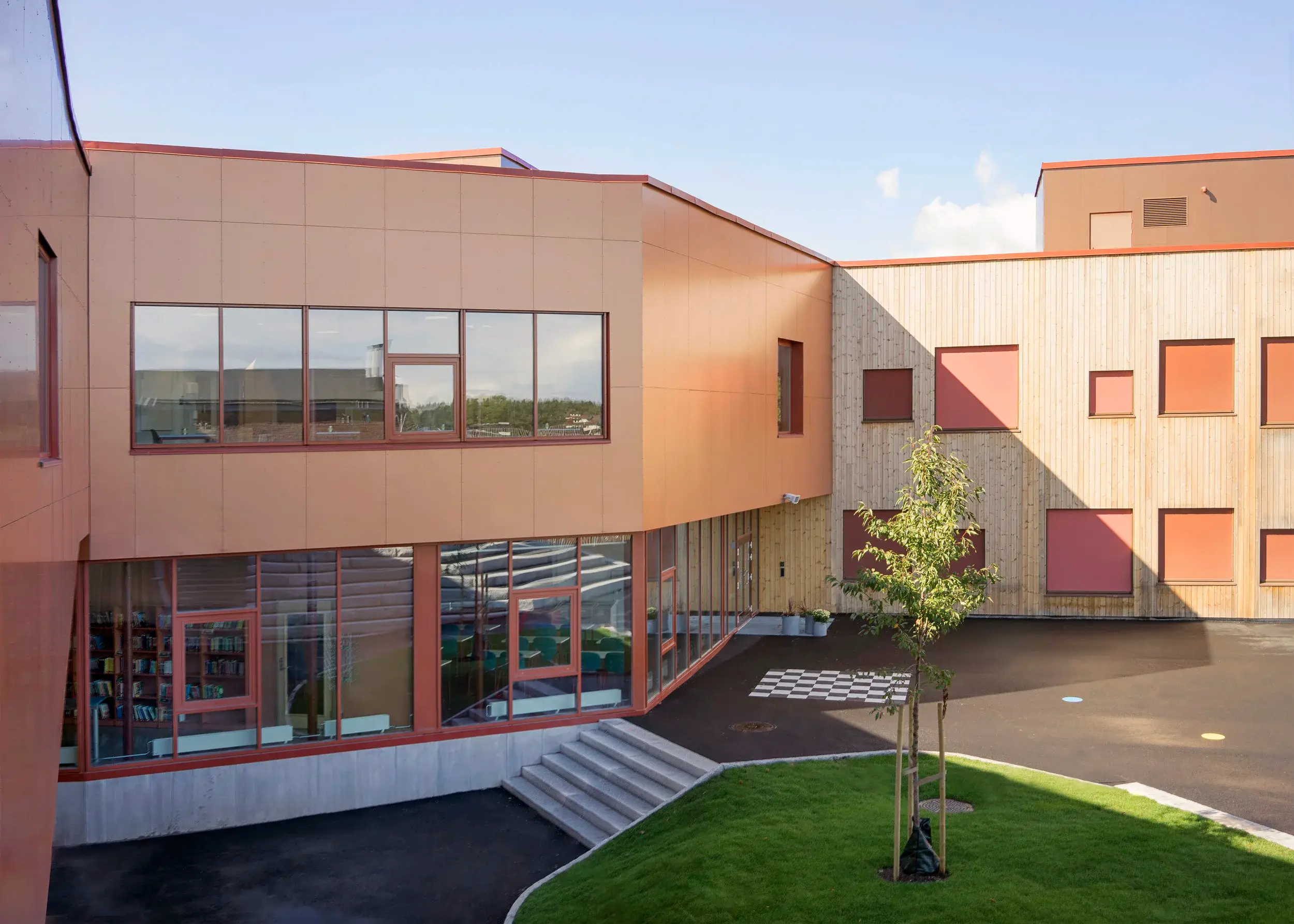
Hebekk School, Ski
Close to the center of Ski, Hebekk School has been expanded and modernized to meet the needs of a rapidly growing municipality. The project includes a new building of 5,400 m² and the rehabilitation of 1,800 m² of existing areas.
Once the steel structures are manufactured, the quality of the assembly determines whether the project is successful. At IPOA, we ensure that the assembly work is done quickly, safely and accurately – every time. With extensive experience from complex construction projects, we know how important it is to have installers with good knowledge, the right equipment and good dialogue with the rest of the project team.
We have our own installation teams who know our products and how to install them effectively. Our installers have solid expertise, valid certificates and extensive experience from both small and large projects. We pride ourselves on tidy construction sites, a good HSE culture and clear communication with project management.
All our projects are closely monitored by a project manager from IPOA, who ensures that all work is documented and quality assured on an ongoing basis.
Thorough control routines and documentation
Certified quality management system
Continuous inspection and follow-up on the construction site
With extensive experience from large deliveries, IPOA knows how crucial efficient logistics is for a successful project. We plan and coordinate deliveries down to the smallest detail, ensuring that all steel is delivered punctually and efficiently – whether the project is in Norway, Sweden or other parts of the Nordic region.
Efficient transport and delivery solutions
Planning and coordination of large volumes
Good logistics planning that reduces costs and time spent
To ensure a smooth process, we work closely with contractors and subcontractors throughout the project. Good communication and clear agreements ensure that work flows efficiently, regardless of the complexity and size of the project.
Clear plans and ongoing communication
Proactive coordination and project management
Experience with complex projects and multidisciplinary deliveries
We know that good communication and solution-oriented partners are crucial for a successful end result.
Steel erection is the process of transporting prefabricated steel elements to a construction site and assembling them into a complete load-bearing structure. The work involves lifting, assembling, bolting and adjusting the structure according to drawings and specifications.
Installation of steel structures involves assembling and securing all structural elements on site. This includes measuring, positioning, fastening and checking tolerances. The work is often carried out in close collaboration with other disciplines such as concrete, technical installations and facade.
Assembly is crucial because even small deviations in construction can affect the stability and function of the entire structure. Accurate assembly ensures that loads are distributed correctly, that the structure meets the design requirements, and that further work can be carried out without problems.
Installation is planned through detailed progress plans, logistics plans and lifting plans. This includes coordination of deliveries, use of cranes and site facilitation. Good planning is essential to avoid delays and ensure efficient execution.
The assembly of steel structures requires specialized equipment such as mobile cranes, lifting equipment, scaffolding and fastening tools. In addition, measuring equipment is used to ensure correct positioning and alignment. The choice of equipment depends on the size and complexity of the project.
HSE is ensured through risk assessments, safe job analysis (SJA) and the use of approved protective equipment. The work is planned to reduce the risk of working at height and heavy lifting. Clear routines and experienced fitters are essential for safe implementation.
Efficient logistics are essential to ensure the correct sequence of assembly. Steel structures are often delivered in sequences adapted to the progress on the construction site. Good planning of transport and storage contributes to reduced time consumption and fewer interruptions in the work.
Assembly is closely coordinated with other disciplines to ensure progress and avoid conflicts on the construction site. This involves ongoing communication, shared progress plans and coordination of work areas. Good collaboration is especially important in complex projects.
Quality assurance is achieved through ongoing control of execution, documentation of work and inspection of critical points. This includes checking bolts, welds and tolerances. Documentation ensures traceability and that the work meets the requirements of the project.
Time required depends on the size, complexity and logistics of the project. Smaller buildings can be assembled quickly, while larger and more complex structures require more time and coordination. Efficient planning and prefabricated elements contribute to shorter assembly times.
Other services

Close to the center of Ski, Hebekk School has been expanded and modernized to meet the needs of a rapidly growing municipality. The project includes a new building of 5,400 m² and the rehabilitation of 1,800 m² of existing areas.

One of Europe's largest biocarbon production facilities is currently being built at Treklyngen Industrial Park in Ringerike. Vow Green Metals is behind the development, and the facility will produce more than 20,000 tons of biocarbon annually as a climate-friendly alternative to fossil coal in the smelting industry. This could reduce CO₂ emissions by around 100,000 tons annually.

A new 9,000 m² production facility for Merkur Grafisk, developed by Pareto Alternative Investments, is being built in Langhus. The building will house production facilities, warehouses and offices, and will be an important addition to the graphic arts community in the region.

Suldal nursing home is beautifully situated on the slope of Sand town centre, with proximity to and views of Sandsfjorden. The modern nursing home has 38 long-term beds adapted for people with varying degrees of dementia and other somatic illnesses. In addition, the building houses a day centre, a commercial kitchen and a central laundry.